









City skyline at dusk with clustered skyscrapers

Passive Fire Protection for Commercial Buildings

Under the Regulatory Reform (Fire Safety) Order 2005, the Responsible Person for a commercial building carries a legal duty to keep its passive fire protection – compartmentation, fire stopping, fire doors, barriers and structural coatings – correctly installed, maintained and evidenced. The hard part in commercial property is churn: every fit-out, tenant change and service alteration disturbs the compartmentation the fire strategy relies on, and most breaches sit hidden above ceilings and in risers until an FRA or a fire finds them.


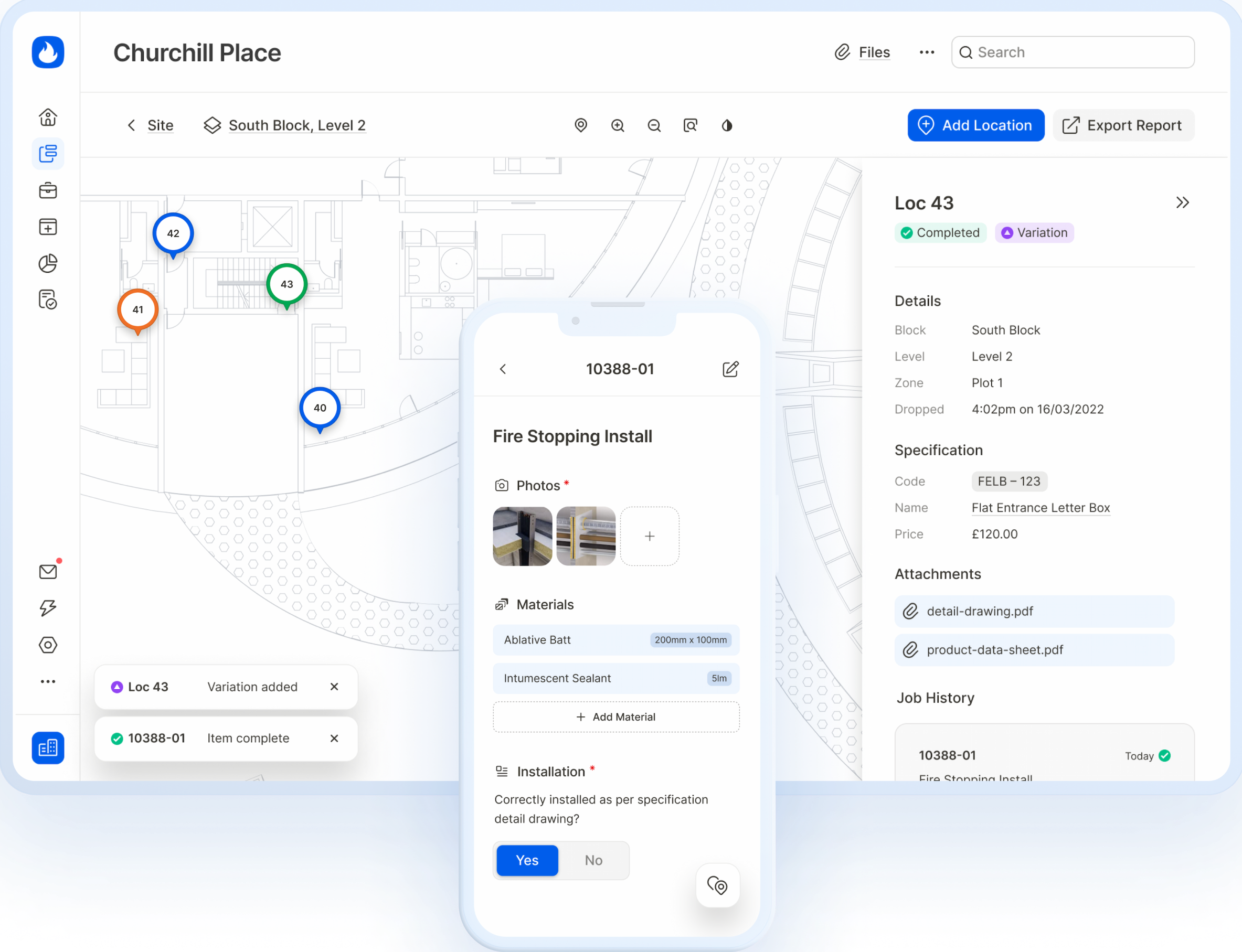
Ark delivers and evidences passive fire protection across offices, retail, hospitality, logistics and mixed-use buildings nationwide – documented in Onetrace, and mapped to the Fire Safety Order, Approved Document B and BS 9999.

citation approved certificate
Constructionline Gold Certification
Firas certification
CHAS cert exp
Acclaim certification logo
SafeContractor Certificate
facilities line gold member logo
ASFP Logo

    What happens when commercial passive fire protection goes wrong

    If the Responsible Person can’t evidence it


    Under the Fire Safety Order, being compliant isn’t enough – you have to be able to prove it. Without records of what was installed, where and to what standard, the Responsible Person can’t demonstrate the compartmentation works. That’s an enforcement exposure with the fire authority, a problem at insurance renewal, and a liability that lands on the building owner, employer or managing agent personally.


    If fit-out and churn aren’t controlled


    Commercial buildings change constantly, and every CAT B fit-out, tenant strip-out and cabling run risks cutting through a compartment wall or floor. Left unsurveyed and unsealed, those breaches accumulate silently – so the building drifts out of compliance between FRAs, and the cost of putting it right multiplies the longer it’s hidden.


    How Ark protects the Responsible Person


    Tested-system installation, post-fit-out compartmentation surveys, and every fire stop, door and barrier captured in Onetrace with product, location, photo and sign-off. The Responsible Person gets a live, auditable record that maps to the Fire Safety Order and BS 9999 – evidence they can hand to the fire authority, the insurer or an incoming tenant without a scramble.

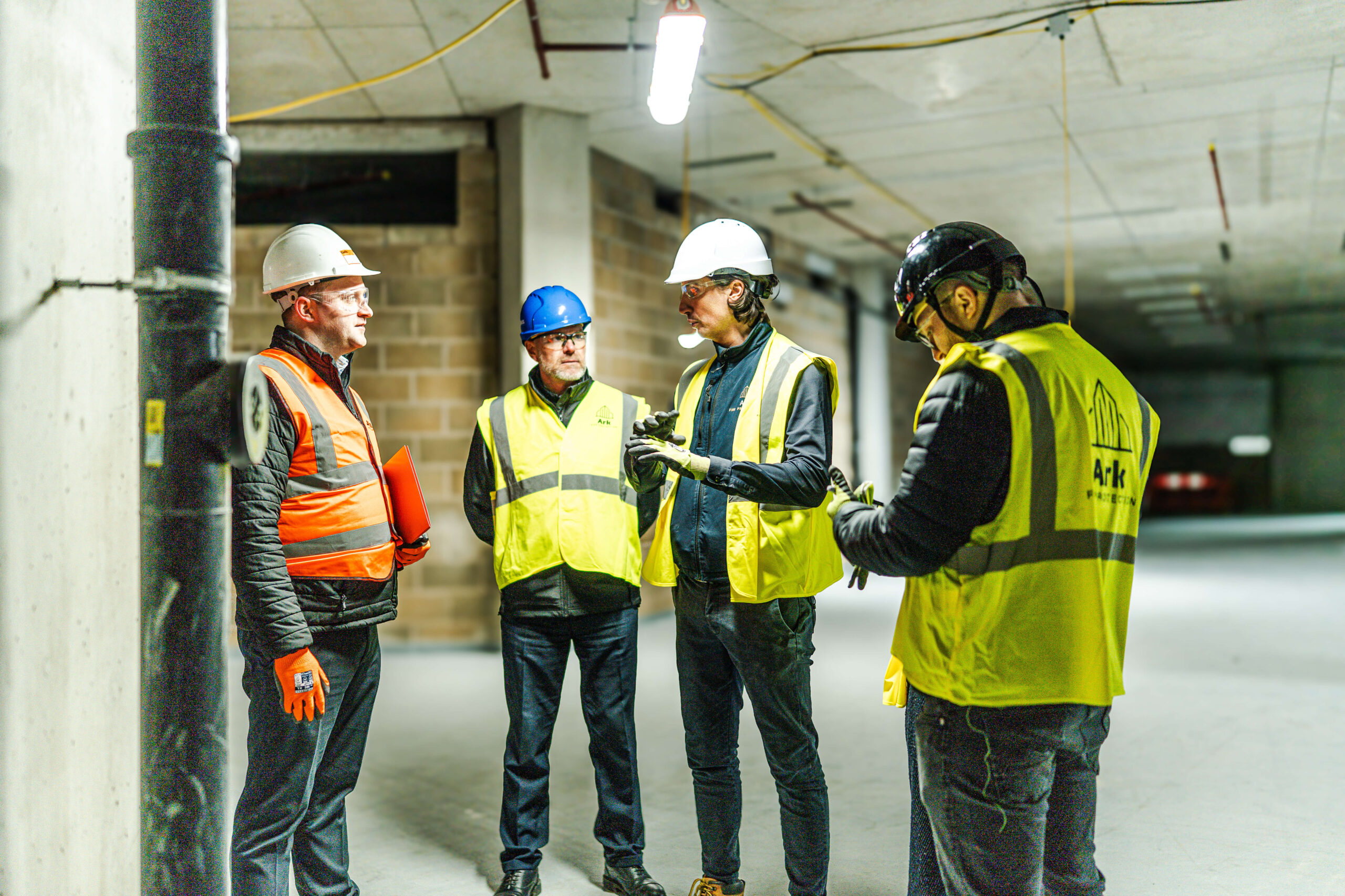
    image w text bg Ark Team in full safety equipment discuss on a commercial site

    Passive Fire Protection by Commercial Building Type

    Different commercial buildings face different fire risks, and the passive fire protection strategy needs to reflect that:


    • Offices – Open-plan layouts, suspended ceilings, and service-heavy floor voids make fire stopping and cavity barriers critical. Fire doors must protect escape routes and lift lobbies; office fit-outs frequently disturb existing compartmentation, so post-fit-out surveys are essential.
    • Retail and shopping centres – High occupancy, large open spaces, and frequent tenant changes require strong compartmentation between units, fire-rated shopfronts, and well-maintained fire curtains in atriums.
    • Hotels and hospitality – Sleeping risk and 24/7 occupancy mean fire doors, compartmentation between bedrooms, and protected escape routes are non-negotiable. Regular fire door inspections are mandatory under the Fire Safety (England) Regulations 2022.
    • Mixed-use developments – Buildings combining residential, retail, and commercial floors require strict compartmentation between use classes, with specific attention to the interfaces between floors and party walls.
    • Warehouses and logistics – Large undivided spaces, high storage racking, and structural steel mean intumescent coatings, fire stopping at service penetrations, and external fire barriers are the priority.
    image w text bg Glass tower reflected beside older brick buildings at dusk

    Commercial Fire Stopping Services

    Our team consists of highly trained professionals who have extensive experience in installing a wide range of passive fire protection systems for all types of commercial buildings. The most effective way at fighting a fire, is to contain it within one compartment, which is where passive fire protection systems come into play.


    These systems are designed to restrict the spread of fire and smoke through walls, floors and doors, providing crucial time for evacuation and saving lives. Partnering with an experienced and professional PFP provider, like ourselves here at Ark Fire Protection, ensures that your building will be equipped with the most effective and reliable solutions – saving you both time and money if your premise is unfortunate enough to experience a fire.


    Get a Free Quote
    Office building windows revealing rows of empty desks at night

    Ark's Commercial Passive Fire Protection Services

    Browse our complete range of passive fire protection services available for our commercial clients. The two most important goals of passive fire protection are to make a structure safer for evacuation and to stop a fire from becoming a danger to life. Browse our services below to see how Ark Fire Protection can help safeguard your commercial property.

    fire stopping logo

    Fire Stopping

    Fire stopping refers to the act of sealing openings to prevent the passage of fire, smoke, and heat between different areas of a building. By creating fire-resistant compartments, both vertically and horizontally, the spread of fire can be effectively contained within commercial buildings. Implementing fire stopping measures is crucial for restricting the spread of fire, and protecting your assets.

    Find out more
    fire door logo

    Fire Doors

    Fire doors are one of the most widespread solutions in the main implementation of creating compartmentation in a building. At Ark Fire Protection we provide a number of services with fire doors, whether you’re looking for a new door closer or a full fire door upgrade for your commercial building, we can offer fire door maintenance with third party accreditation.

    Find out more
    intumescent coating logo

    Intumescent Coatings

    Intumescent coatings are a proven and effective solution for safeguarding commercial buildings against structural damage risks. At Ark Fire Protection, we meticulously test all our intumescent coatings to meet EU standards, instilling confidence in our customers that their buildings are equipped with advanced fire protection. Rest assured, our coatings offer superior defence against potential threats to the structural elements of your property.

    Find out more
    fire barrier logo

    External Fire Barriers

    External Fire Barrier systems offer a comprehensive solution for preventing the spread of fire and smoke in commercial premises, specifically within roof and ceiling areas as well as concealed voids. These fire barrier systems are designed to be effective for voids located up to 10.5 metres. Vertical fire barrier systems provide a combination of insulation and integrity, offering protection for up to 120 minutes.

    Find out more
    fire curtain logo

    Fire Curtains

    Ark Fire Protection offers the installation & maintenance of fire curtains made of flexible fibre specifically designed for installation in hard-to-reach areas or areas lacking structural supports that may experience movement, such as ceiling voids or lofts. Whether you require integrity or insulation, we provide a complete range of fire curtains to meet the specific needs of our commercial customers.

    Find out more
    partitions logo

    Partitions

    Fire partitioning is a crucial safety measure implemented during the construction of commercial properties in order to inhibit the rapid spread of fire. It entails the creation of internal walls and ceilings that confine the fire within a specific room or area of the building for a limited duration. This tactical approach enables occupants to swiftly locate escape routes while mitigating damage to the overall structure.

    Find out more
    fire rememdial work logo

    Fire Remedial Works

    Our fire risk assessment (FRA) services for commercial buildings involve the reinstatement or enhancement of various passive fire protection measures that currently fall short of the required fire safety standards. Through our remedial works, we aim to elevate your building’s fire safety standards to the appropriate level, ensuring compliance with current guidelines and regulations.

    Find out more
    get in touch logo

    Get in touch!

    Whether you have questions, require further information, or would like to discuss your specific needs for passive fire protection solutions, our dedicated team is here to assist you.

    Speak to a PFP Specialist

    Accredited Commercial Fire Stopping

    When it comes to Passive Fire Protection, you need a company that you can rely on. Ark Fire Protection is proud to be accredited by the leading industry bodies – ensuring that we always meet the highest standards of quality and safety, and that our customers can always expect a first-class service.


    We’re also ISO 9001 certified, meaning that our quality management systems are regularly audited and approved. So when you choose Ark Fire Protection, you can be confident that you’re making the best possible decision for your property.

    Full-Scope Commercial Passive Fire Protection Solution

    We provide end-to-end passive fire protection solutions for commercial properties, ranging from design and installation to maintenance and remedial works. This all-inclusive approach ensures that your building is fully equipped with the most advanced PFP systems, while adhering to the highest industry standards. Trust us at Ark Fire Protection to provide a reliable and comprehensive solution for protecting your commercial premises against fire hazards. Contact us today to learn more about our services and how we can help safeguard your business or commercial property.

    image w text bg Cluster of modern skyscrapers in a city skyline at dusk

    Great commercial passive fire protection projects start with great technology

    For a commercial Responsible Person, Onetrace turns a building’s passive fire protection into a live, defensible record rather than a folder that goes stale the moment the next fit-out starts. Every fire stop, door, barrier and coating is logged with product, location, photo and sign-off – so compartmentation can be evidenced on demand for the fire authority, the insurer, an FRA assessor or an incoming tenant, and each round of churn is captured against the record instead of quietly eroding it.

    Speak to a PFP Specialist
    Onetrace app tracking a fire stopping installation task

    Ark Commercial Fire Protection Services

    Ark Fire Protection can supply and install a full range of solutions for fire stopping not limited to but including, load-bearing compound fire seals, batt and mastic seals, graphite’s, wraps, collars and linear joint seals incorporating deflection when needed. All fire stopping installations are third party accredited by FIRAS scheme, Health & Safety accredited and ISO 9001 quality assured.

    Speak to a PFP Specialist

    Commercial fire safety standards & regulations

    Commercial fire safety sits across building regulations, a statutory management duty, and the design and management codes the sector works to. Ark installs and documents against the full framework:


    • Regulatory Reform (Fire Safety) Order 2005 – the day-to-day statutory duty on the Responsible Person for every non-domestic building – to assess, manage and evidence fire safety, including passive fire protection.
    • Building Regulations 2010, Approved Document B, Volume 2 – the compliance baseline for fire safety in buildings other than dwellings – compartmentation, means of escape, internal fire spread and structural protection.
    • BS 9999 – the code of practice for fire safety in the design, management and use of non-domestic buildings – the risk-based framework most commercial fire strategies are actually built on, alongside Approved Document B.
    • Fire Safety Act 2021 – clarified that the Fire Safety Order covers a building’s structure, external walls and flat entrance doors – directly relevant to mixed-use buildings with residential above commercial.
    • Fire Safety (England) Regulations 2022 – where a commercial building has residential parts over 11m, brings duties for communal and flat-entrance fire-door checks and resident information.
    • Building Safety Act 2022 – for higher-risk buildings – including mixed-use schemes 18m+ with residential – adds Accountable Person duties, the golden thread and Building Safety Regulator oversight.
    • Regulation 38 of the Building Regulations – requires fire safety information to be handed to the Responsible Person at completion – the evidence pack Ark produces is exactly what this calls for.
    image w text bg Bright and modern ceiling

    What Is Passive Fire Protection in Commercial Buildings and Why Is It Needed?

    Passive fire protection in commercial buildings refers to the systems and construction measures that limit the spread of fire and smoke, protect escape routes, and preserve structural stability without requiring activation. These measures are built into the fabric of offices, retail units, mixed use developments, and other commercial spaces, and are expected to perform continuously throughout the life of the building.


    Commercial environments present particular fire safety challenges, including high occupancy levels, open plan layouts, extensive service penetrations, and frequent refurbishments. Without effective passive fire protection, fire and smoke can spread rapidly through floors, voids, and shared areas, placing occupants at risk and causing significant disruption to business operations. Properly designed and maintained passive fire protection helps commercial buildings remain safe, compliant, and operational even in the event of a fire.

    image w text bg Glass tower with yellow balconies against a blue sky

    Our Recent Work in the Commercial Sector

    At Manchester Fire Station we supplied and installed Corofil cavity barriers and slab-edge systems to achieve the fire resistance set out in the building’s façade fire strategy, delivered in a live operational building with no delays to its day-to-day running. On larger mixed-use schemes such as St William’s Clarendon development, we’ve delivered fire stopping to both 60 and 120-minute ratings across residential, commercial and public spaces. It’s representative of how we work across commercial and public buildings – to the fire strategy, around the occupier, and with the documentation to match.

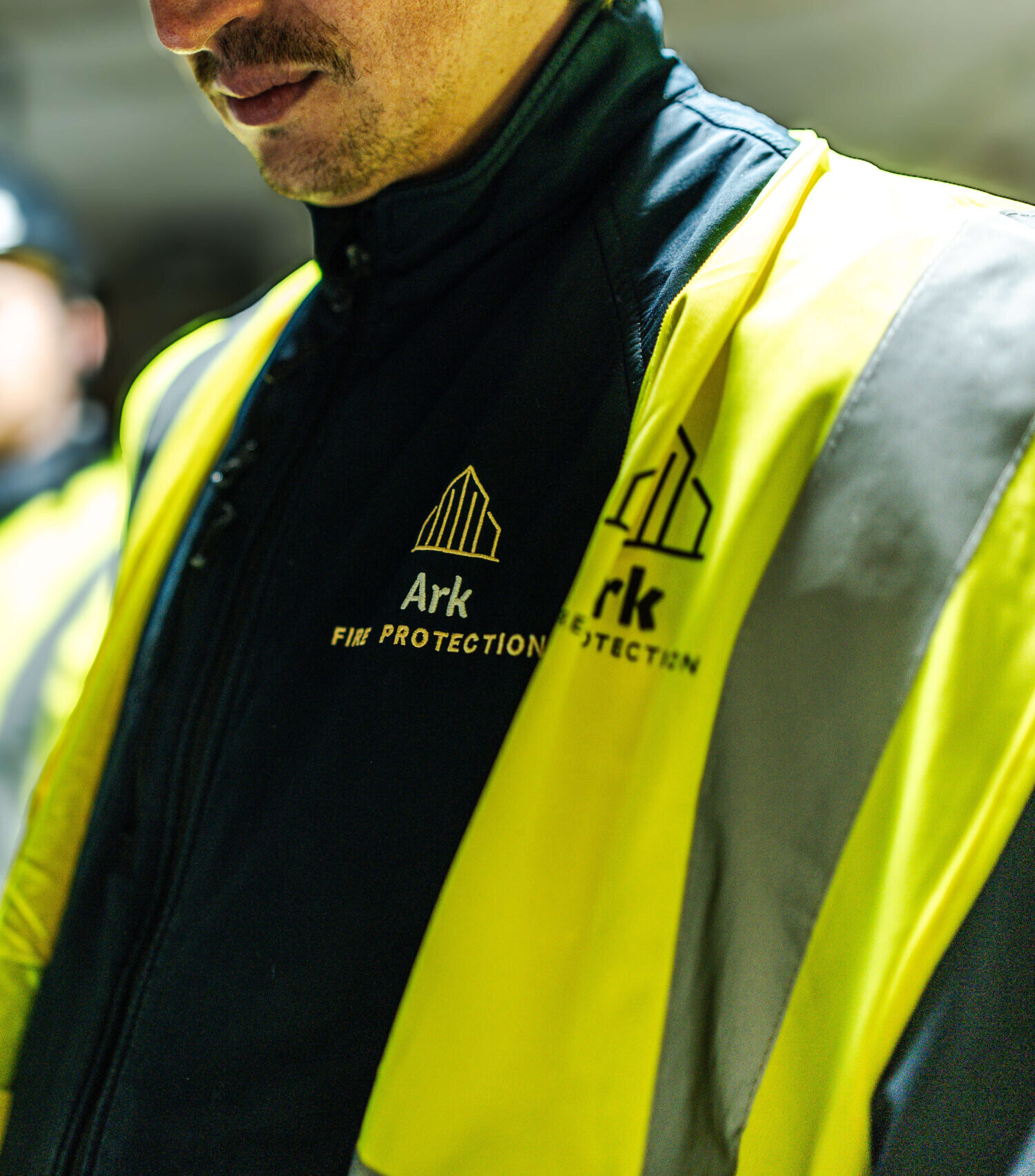
    image w text bg Ark Fire Protection Jacket & High Vis.

    Commercial Passive Fire Protection FAQs

    What is commercial passive fire protection?

    Commercial passive fire protection refers to built in fire safety systems used in offices, retail spaces, and other commercial buildings to contain fire and smoke. These systems include fire resisting walls and floors, fire doors, fire stopping, barriers, and protective linings, all designed to work without manual or automatic activation.

    Why is passive fire protection especially important in commercial buildings?

    Commercial buildings often have high footfall, shared escape routes, and complex layouts. Passive fire protection helps control fire spread in these environments, protecting occupants and reducing disruption to business operations.

    Who is responsible for passive fire protection in a commercial property?

    The responsible person, usually the building owner, employer, or managing agent, is legally responsible for ensuring passive fire protection systems are installed correctly, maintained, and documented.

    How often should passive fire protection be inspected in commercial buildings?

    Inspection frequency depends on building use and risk, but most commercial properties require at least annual inspection, with additional checks following refurbishments, fit outs, or service installations.

    Can passive fire protection be installed or upgraded without disrupting business?

    Yes. Many passive fire protection works can be planned around business operations, including out of hours installation and phased programmes to minimise disruption.

    What is BS 9999 and how does it apply to commercial buildings?

    BS 9999 is the British Standard code of practice for fire safety in the design, management and use of non-domestic buildings. Unlike Approved Document B, which sets out minimum compliance requirements, BS 9999 provides a risk-based framework that allows designers and building managers to tailor fire safety strategies to the specific use and risk profile of a building. In commercial properties, it is commonly applied alongside Approved Document B to support more flexible or complex fire strategies.

    Do offices need fire doors?

    Yes. Fire doors are required in offices wherever they form part of a protected escape route – such as stairwell doors, lobby doors, and doors into protected corridors. Under the Regulatory Reform (Fire Safety) Order 2005, the Responsible Person must ensure that fire doors are correctly specified, installed, and maintained. In practice, any open-plan office fit-out that alters compartmentation will likely require fire door upgrades or replacements.

    What is compartmentation in a commercial building?

    Compartmentation is the division of a building into fire-resistant sections – compartments – using fire-rated walls, floors, doors, and fire stopping around service penetrations. The aim is to contain a fire within the compartment where it starts, limiting its spread and protecting escape routes. In commercial buildings, compartmentation requirements are set out in Approved Document B and BS 9999, and must be maintained throughout the life of the building, including after refurbishments and fit-outs.

    How long does commercial passive fire protection installation take?

    Timescales depend on the scope of work. A fire stopping package for a single floor of a commercial building may take a few days; a full passive fire protection programme across a multi-floor development or large retail unit may take several weeks. At Ark, we plan programmes around your business operations and can phase work to minimise disruption, including out-of-hours installation where required.

    What fire safety evidence does a commercial Responsible Person actually need?

    Enough to demonstrate the building’s passive fire protection is installed and maintained to standard: product and system records, installation evidence, photographs, locations and sign-offs, plus the Regulation 38 fire safety information handed over at completion. Ark produces this as a digital record in Onetrace, so it can be produced on demand rather than reconstructed.

    Do we need a compartmentation survey after a fit-out or refurbishment?

    Almost always, yes. CAT B fit-outs, strip-outs and re-cabling routinely breach compartment walls and floors above ceilings and in risers. A post-works compartmentation survey identifies and seals those breaches before they become an FRA finding or an enforcement issue – and Ark can carry out both the survey and the remediation, closing the loop with evidence.

    Working With Leading Manufacturers