







Industrial Fire Stopping

Industrial Passive Fire Protection & Fire Stopping

Industrial buildings are prone to fire accidents due to their nature and the activities being carried out within them. The risk of a fire outbreak in an industrial facility can result in significant damage, loss of life, and disruption of business operations. At Ark Fire Protection, we can help mitigate this risk by providing industry-leading industrial passive fire protection solutions.

facilities line gold member logo
ASFP Logo

Ensure the Safety of Your Building with Industrial Passive Fire Protection

Our team comprises skilled experts with extensive experience in installing a diverse range of passive fire protection systems for various industrial structures. The most efficient approach to tackling fires is through containment within a single compartment, and this is precisely where passive fire protection systems play a crucial role.


These systems are meticulously engineered to contain the spread of fire and smoke, safeguarding lives by allowing crucial time for evacuation. By partnering with an experienced and professional PFP provider such as Ark Fire Protection, you can ensure that your building is equipped with the most efficient and dependable solutions. This not only saves you time and money, but also provides peace of mind in the unfortunate event of a fire incident.


Get in touch

Ark's Industrial Passive Fire Protection Services

Discover our comprehensive range of passive fire protection services, tailored for our industrial clientele. The objectives of passive fire protection encompass enhancing structural safety for effective evacuation and mitigating the risks by potential fires. Browse our range of services below to learn how Ark Fire Protection can effectively safeguard your industrial property.

Fire Stopping

Fire stopping involves sealing openings in order to prevent the passage of fire, smoke, and heat between different sections of a building. By establishing fire-resistant compartments both vertically and horizontally, the spread of fire can be effectively contained within industrial structures. It’s essential to implement fire stopping measures to limit the spread of fire and protect your assets.

Find out more

Fire Doors

Fire doors are a widely adopted solution for creating compartmentation within buildings. We offer a range of services related to fire doors. Whether you require a new door closer or a complete fire door upgrade for your industrial facility, our fire door maintenance services come with third-party accreditation. Rest assured that we prioritise the quality and safety of your fire doors.

Find out more

Intumescent Coatings

Intumescent coatings provide a proven and effective solution for protecting industrial buildings from structural damage risks. We conduct rigorous testing on all our intumescent coatings to ensure they meet EU standards. This instils confidence in our customers, knowing that their buildings are equipped with advanced fire protection. Rest assured, our coatings offer superior defence against potential threats to the structural elements of your property.

Find out more

External Fire Barriers

External Fire Barrier systems offer a comprehensive solution to prevent the spread of fire and smoke in industrial premises. Specifically designed for roof and ceiling areas, as well as concealed voids, these fire barrier systems are highly effective for voids up to 10.5 metres. Vertical fire barrier systems provide a perfect combination of insulation and integrity, ensuring protection for up to 120 minutes.

Find out more

Fire Curtains

Ark Fire Protection specialises in the installation and maintenance of fire curtains. These curtains are made of flexible fibre, specifically designed for areas that are difficult to access or lack structural supports, such as ceiling voids or lofts. Whether you need curtains for integrity or insulation, we offer a comprehensive range of options to meet the specific requirements of our industrial customers.

Find out more

Partitions

Fire partitioning is an indispensable safety measure implemented during the construction of industrial properties to prevent the rapid spread of fire. It involves creating internal walls and ceilings that confine the fire within a designated room or area of the building for a limited time. This strategic approach allows occupants to quickly locate escape routes while minimising damage to the entire structure.

Find out more

Fire Remedial Works

Our fire risk assessment (FRA) services for industrial buildings focus on improving passive fire protection measures that do not meet the necessary fire safety standards. We undertake remedial works to elevate your building’s fire safety standards to the required level, ensuring compliance with current guidelines and regulations. Our aim is to enhance the quality of fire protection in your facility, providing you with peace of mind and a safer working environment.

Find out more

Get in touch!

Whether you have questions, require further information, or would like to discuss your specific needs for passive fire protection solutions, our dedicated team is here to assist you.

Contact Us

Accredited Industrial Passive Fire Protection Company

When it comes to Passive Fire Protection, you need a company that you can rely on. Ark Fire Protection is proud to be accredited by the leading industry bodies – ensuring that we always meet the highest standards of quality and safety, and that our customers can always expect a first-class service.


We’re also ISO 9001 certified, meaning that our quality management systems are regularly audited and approved. So when you choose Ark Fire Protection, you can be confident that you’re making the best possible decision for your property.

Full-Scope Industrial Passive Fire Protection Solution

At Ark Fire Protection, we offer complete passive fire protection solutions for industrial properties. Our services encompass everything from design and installation to maintenance and remedial works. With our comprehensive approach, we ensure that your building is equipped with state-of-the-art PFP systems that meet the highest industry standards. You can trust us to provide a reliable and efficient solution for protecting your industrial premises against fire hazards. Contact us today to learn more about our services and how we can help safeguard your industrial property or warehouse.

image w text bg

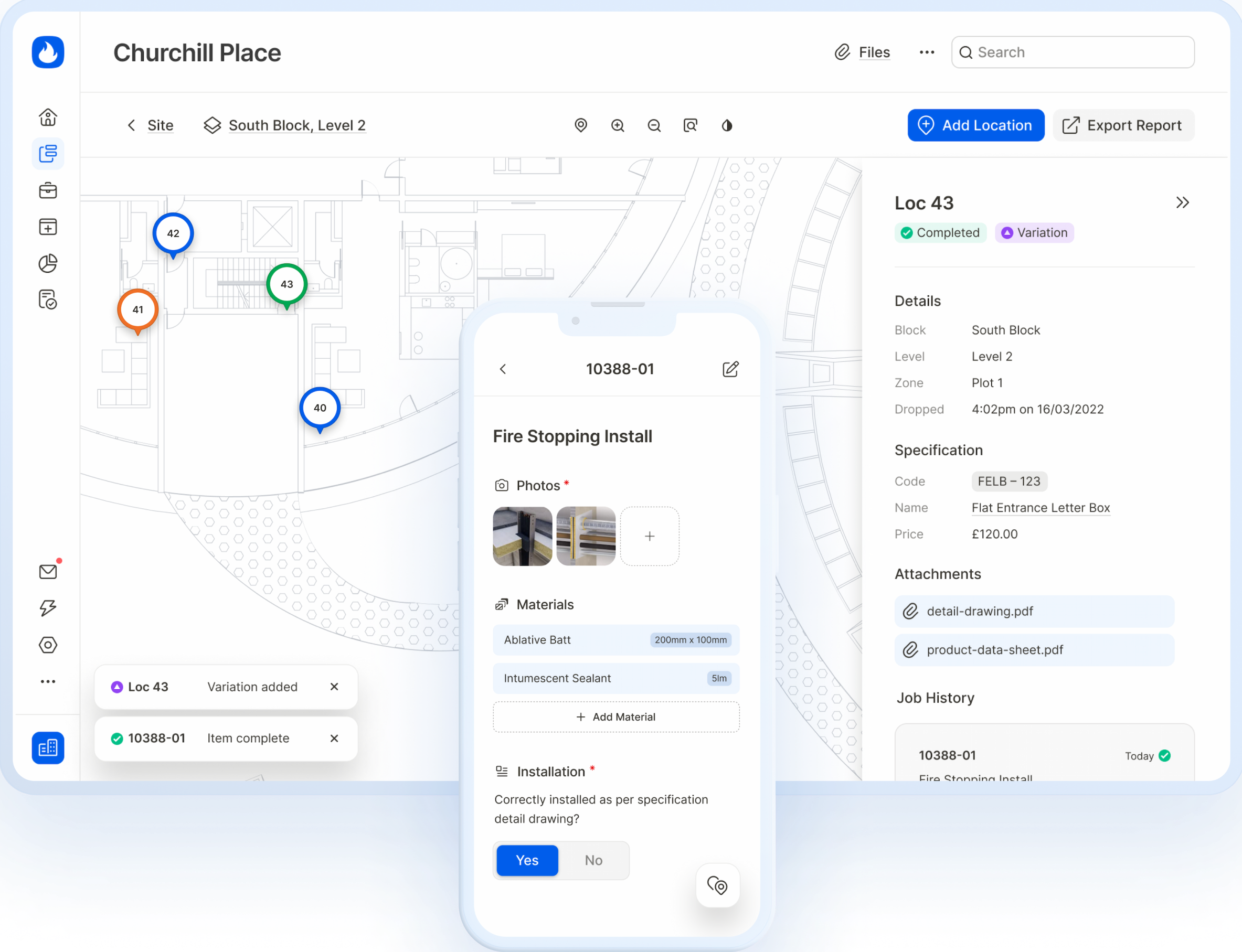
Great industrial passive fire protection projects start with great technology

Onetrace is a powerful cloud-based application that is supporting Ark Fire Protection to raise standards across the fire protection industry.


Providing Ark with one system to capture, monitor, review and report on all fire protection work being conducted in real time.

Get in touch

Ark Fire Protection's Industrial Fire Protection

Ark Fire Protection can supply and install a full range of solutions for fire stopping not limited to but including, load-bearing compound fire seals, batt and mastic seals, graphite’s, wraps, collars and linear joint seals incorporating deflection when needed. All fire stopping installations are third party accredited by FIRAS scheme, Health & Safety accredited and ISO 9001 quality assured.

Get in touch

Industrial Fire Stopping Regulations

Ark Fire Protection ensures that buildings remain in compliance with fire regulations. Our highly skilled team provides a wide range of passive fire protection products to assist you in effectively meeting these standards.


As per the 2020 amendments to the Building Regulations Act of 2010 on Fire Safety for Volume 1: Dwellings, it is crucial for buildings to effectively inhibit the spread of fire through internal linings while simultaneously fulfilling other necessary criteria.


  • The premature collapse of the structure is avoided
  • Adequate measures have been taken to ensure that there is enough distance between buildings and within buildings to prevent the spread of fire
  • Wherever it is needed, automatic fire suppression is available.
  • The spread of fire and smoke in cavities is limited


The document and its amendments outline the appropriate procedures for implementing fire stopping measures. Our team of specialists can provide valuable assistance throughout this process to guarantee optimal protection for your industrial property.

image w text bg Regulations

What Is Passive Fire Protection in Industrial Buildings and Why Is It Needed?

Passive fire protection in industrial settings refers to built-in structural and compartmentation measures that limit the spread of fire and smoke, protect escape routes, and help maintain the stability of key building elements without requiring activation. These measures include fire resisting walls and floors, fire doors, fire stopping around services, cavity and fire barriers, and protective coatings on structural steel.


Industrial environments such as factories, manufacturing plants, and warehouses often contain a combination of heavy machinery, combustible materials, and complex service installations. Fire can spread rapidly through large open spaces, concealed voids, and service penetrations if not properly compartmentalised. Passive fire protection helps contain fire within defined zones, giving occupants more time to evacuate safely and reducing damage to plant, stock, and equipment. In the UK, effective passive fire protection is also essential for meeting legal requirements under Building Regulations Approved Document B and the duties placed on employers and owners under the Regulatory Reform (Fire Safety) Order 2005.

image w text bg

Benefits of Passive Fire Protection in Industrial Settings

Protection of critical plant and infrastructure

Passive fire protection helps shield essential structural elements, production areas, and supporting infrastructure from early fire damage. This reduces the risk of structural failure that could lead to prolonged shutdowns or unsafe working conditions following an incident.

Improved safety for shift-based and lone workers

Many industrial sites operate extended hours with reduced staffing levels at certain times. Effective compartmentation and fire resisting construction provide additional time for detection, evacuation, and emergency response when fewer people are on site.

Support for compliance and oversight

Regular inspection and maintenance of passive systems demonstrate adherence to regulatory requirements and support audit readiness.

Adaptability to changing industrial layouts

Industrial facilities frequently evolve as production lines, machinery, and storage needs change. Passive fire protection systems can be assessed, adapted, and upgraded to ensure ongoing compliance as layouts and processes are modified.

Working With Leading Manufacturers

Industrial Passive Fire Protection FAQs

What passive fire protection measures are commonly used in industrial buildings?

Typical measures include fire resisting partitions and walls, fire doors and hardware, fire stopping around services, cavity and fire barriers, and fire-resistant coatings on structural steel elements. Each plays a role in maintaining compartmentation and protecting escape routes.

How is passive fire protection in industrial settings different from other sectors?

Industrial environments often have large open spaces, complex services, high fire loads, and varied activity patterns. This increases the need for robust compartmentation and specialised solutions that address rapid fire spread through voids and penetrations.

Who is responsible for passive fire protection in an industrial building?

The responsible person, usually the site owner, employer, or facilities manager, is accountable under the Regulatory Reform (Fire Safety) Order 2005 for ensuring passive fire protection systems are installed, maintained, and documented.

How often should passive fire protection be inspected in industrial facilities?

Passive fire protection should be inspected at least annually, with more frequent checks in high-risk or heavily used areas. Any changes to building layout or services must trigger a reassessment of fire protection.

Can passive fire protection be added to existing industrial buildings?

Yes. Passive fire protection can be retrofitted or upgraded as part of refurbishment, expansion, or risk reduction measures, provided solutions are designed to meet relevant standards and fire strategy requirements.

What impact does passive fire protection have on business continuity?

By containing fire and limiting smoke spread, passive protection reduces damage to stock, machinery, and infrastructure, helping businesses resume operations more quickly after an incident.